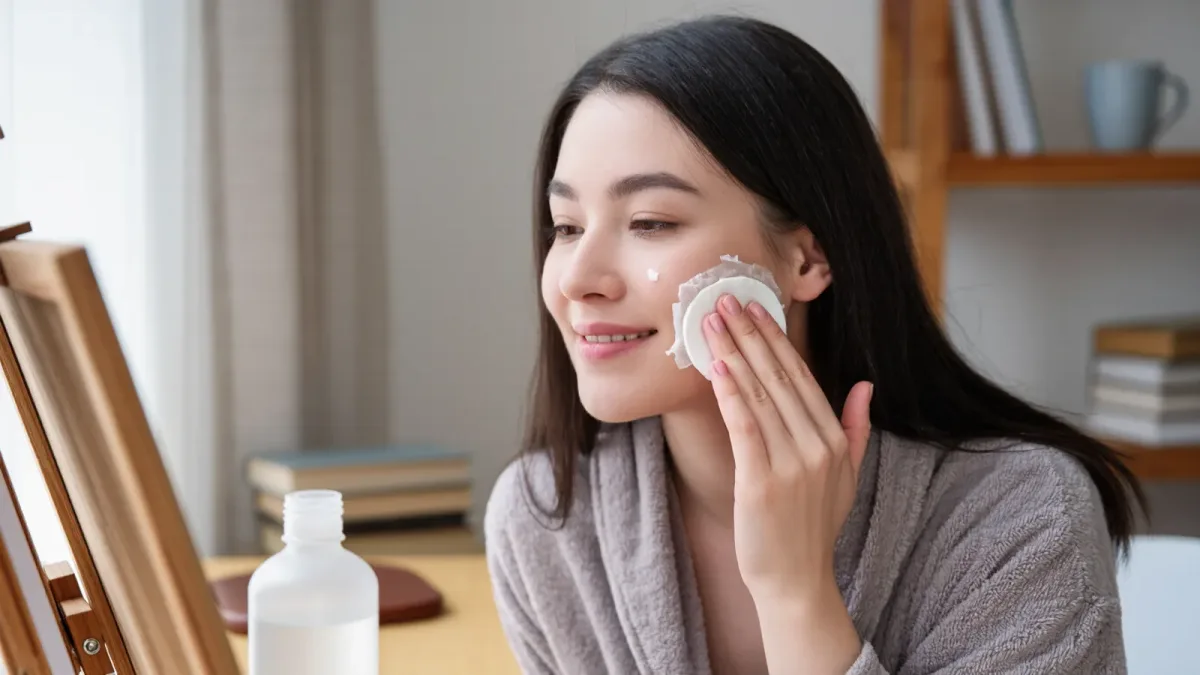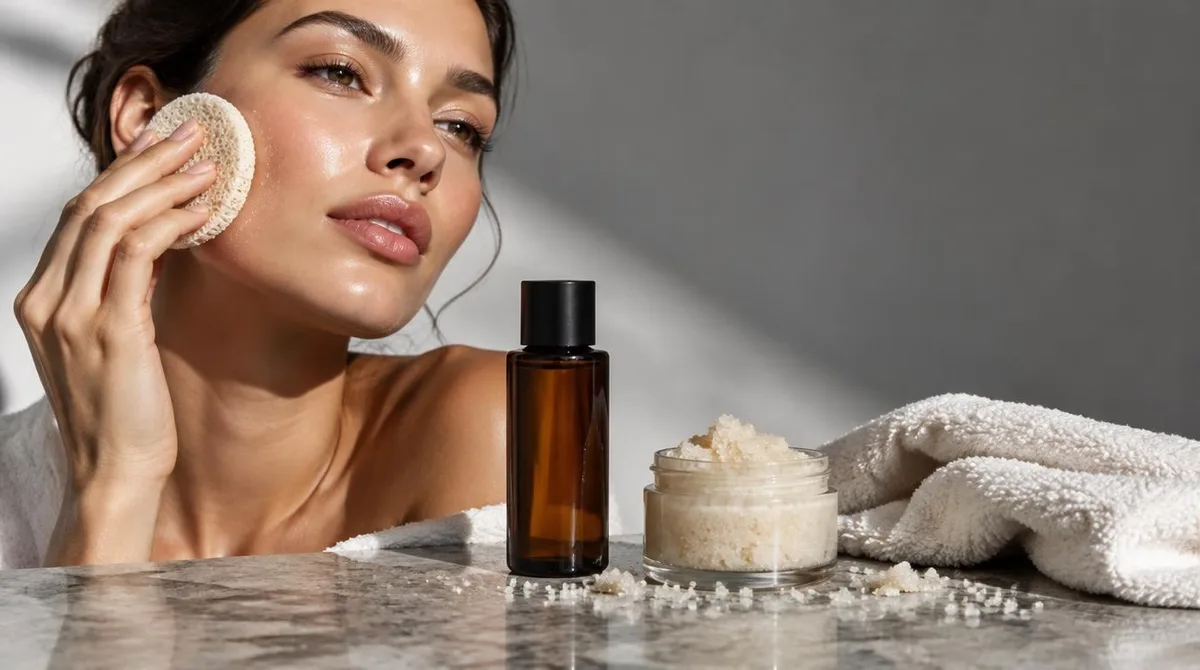
A physical exfoliant is a scrub, a brush, or a pad that removes dead skin cells by friction. A chemical exfoliant is an acid, glycolic or salicylic, that dissolves them instead. Both clear the surface. The routes differ, and so do the risks. The American Academy of Dermatology puts it plainly: done badly, the process can do more harm than good.
The difference lives in the mechanism, and the mechanism predicts who tolerates what. Below is how each method works, which skin types each suits, and the warning signs dermatologists name. This connects to our earlier piece, Mineral vs. Chemical Sunscreen: Which One Should You Actually Buy?.
What Counts as Physical Exfoliation?
Friction does the work. Mechanical exfoliation, per the academy, uses a tool such as a brush, pad, or sponge, or a scrub to physically remove dead skin cells. The encyclopedia’s entry lists the hardware: microfiber cloths, microbead scrubs, crushed apricot kernel, sugar or salt crystals, pumice, loofahs.
Pressure is the part the user controls. The same entry advises people with dry skin to avoid scrubs heavy on pumice or crushed volcanic rock. It also notes pumice is known as a material for the feet. Grit has a job description, and the face is rarely it.
What Does Chemical Exfoliation Actually Do?
It loosens the bonds that hold spent cells on. Per the encyclopedia, the acid roster is long: alpha-hydroxy acids such as glycolic, lactic, mandelic, and citric. Beta-hydroxy acids such as salicylic. Polyhydroxy acids. Enzymes. Their chemistry is direct: they weaken cell adhesion, so the cells ease away. Only the AHAs and BHAs sell for daily use. High strengths stay with medical professionals.
Position matters as well. Per the same entry, AHAs clear the outer layer of skin while BHAs penetrate and clean from within. A product’s active, not its texture, decides how deep the work goes.
What Does Salicylic Acid Do That a Scrub Cannot?
Salicylic acid carries the deepest paperwork of the acids. Dermatologist Taskeen Arif reviewed it in Clinical, Cosmetic and Investigational Dermatology in 2015, and the paper’s finding is its power to exfoliate the stratum corneum, the skin’s outermost layer. That makes it a good peeling agent, in the author’s words. The review reclassifies the acid as a desmolytic. It disrupts the junctions between cells instead of breaking keratin filaments. The author ties that comedolytic, or comedone-clearing, property to acne care.
The same paper records safety and efficacy in light and deep Fitzpatrick skin types. Gentle is not the record, though. The review covers side effects, and salicylism gets its own account. Strength cuts both ways.
Which Method Should Which Skin Type Pick?
The academy maps methods to skin directly. Dry, sensitive, or acne-prone skin may do better with a washcloth and a mild chemical exfoliator. Mechanical scrubbing can be too much for that skin, per the academy. Oily, thicker skin may take stronger chemical treatments or mechanical methods.
Two cautions ride along. Retinoids and benzoyl peroxide can leave skin sensitive or prone to peel, the academy warns. Scrubbing alongside them may worsen dry skin or trigger breakouts. Darker skin tones draw a second caution: aggressive methods can lead to dark spots there, per the same page. The products already in the cabinet answer half of the method question. Readers following this should also see Benzoyl Peroxide vs. Salicylic Acid: Which Fights Breakouts Better?.
How Often, and What Are the Overdoing Signs?
The academy’s schedule rule is a ratio. The stronger the method, the less often it needs doing. Overdone scrubbing shows up as red, irritated skin, per the same guidance. Cuts, wounds, and sunburn cancel the step entirely.
- 1. Apply with small, circular motions for about 30 seconds, per the academy.
- 2. Rinse with lukewarm water, not hot.
- 3. Keep strokes short and light on a brush or sponge.
- 4. Moisturize right after, since the step can be drying.
- 5. Skip broken or sunburned skin entirely.
The guidance closes with a human check. A board-certified dermatologist can evaluate skin and judge whether the step helps, the page says. An ingredient list does not replace that visit.
Conclusion: Same Surface, Different Risks
Both routes end at the same place, a cleared outer layer. Friction removes spent cells by force. Acids loosen the junctions holding them on, per the dermatology review. Skin type picks the method, current products set the limits, and frequency follows strength. The method serves the skin, never the reverse.