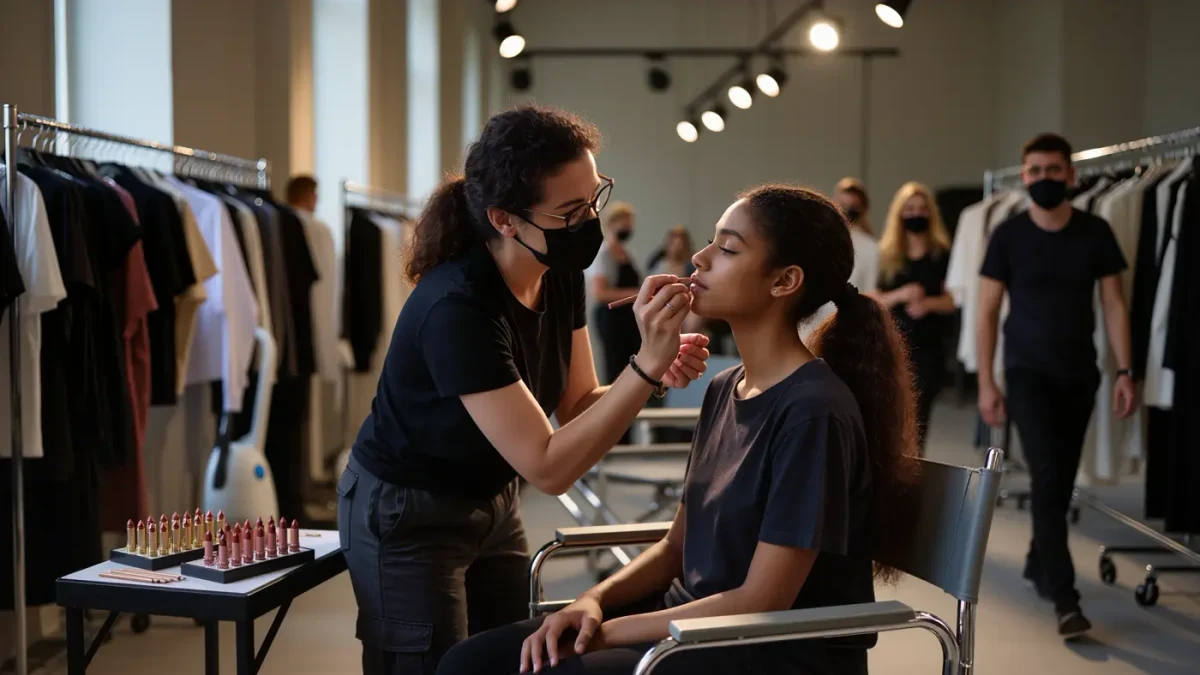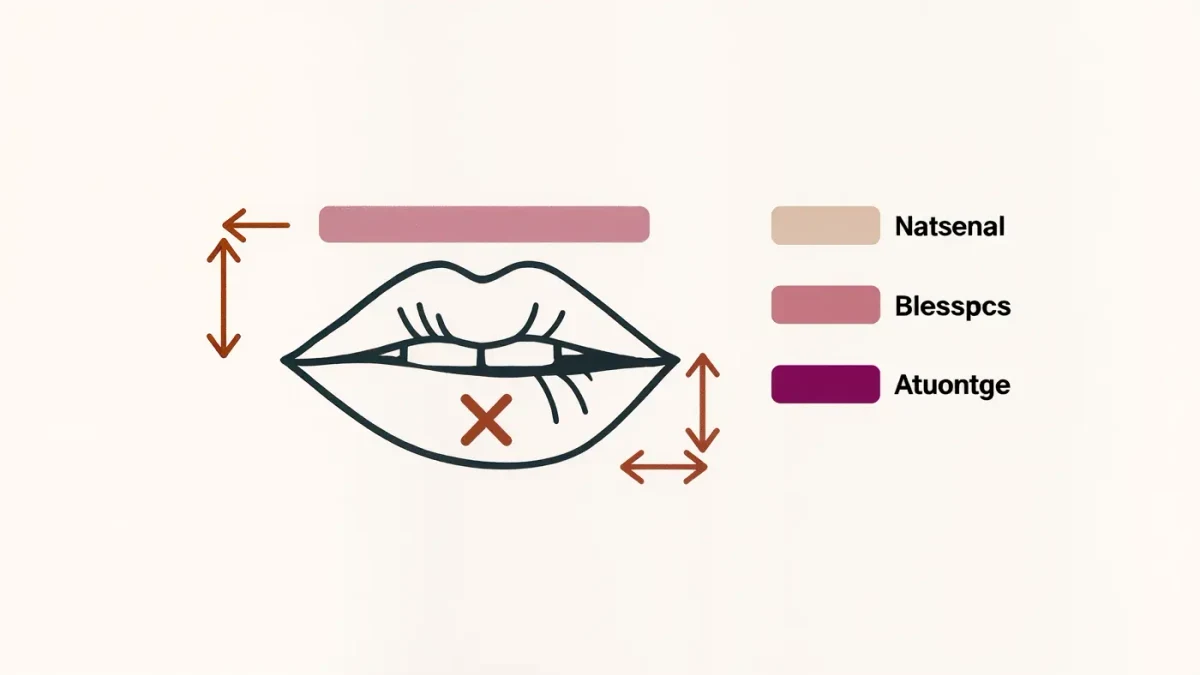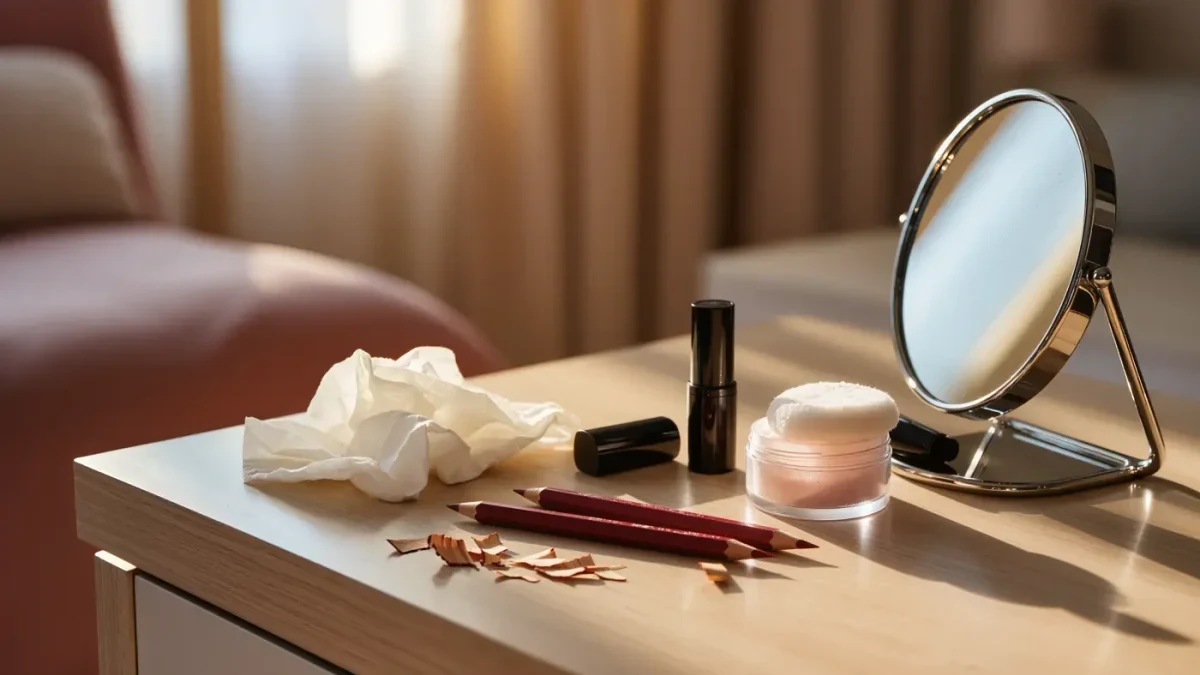
Lipstick bleeds when a fluid formula travels along fine lines and dry skin around the mouth, and the fix is a four-step barrier: prep and lightly exfoliate the lips, line and fill the entire lip with a waxy lip liner, blot the lipstick to a thin film, then press a translucent powder barrier just outside the lip line. Each step removes one cause of travel — texture, slip, excess product, and open track lines respectively. Makeup artists rely on this sequence for mature clients and glossy formulas, the two highest-risk combinations.
Cracking, persistent flaking, or sores at the corners of the mouth are skin conditions, not makeup problems — a dermatologist should look at them before you layer more product over them. What follows is technique, as working artists teach it, plus what brands state about their own formulas.
Why does lipstick bleed into lines at all?
Two mechanisms, and knowing them makes the fixes obvious. The first is capillary travel: lipstick is pigment suspended in oils and waxes, and liquid oil spreads along any groove it meets — perioral fine lines, dry lip edges, and the tiny crease at the cupid's bow all act as channels. The second is gravity and muscle movement: the mouth moves hundreds of times an hour, and every flex pumps soft formulas outward. Thin, oily, gloss-heavy formulas move most; dense waxy formulas move least. Age matters too — after roughly the mid-thirties, collagen loss deepens the vertical lines above the lip, which is why feathering becomes a bigger complaint with mature skin, a point dermatologists and artists make alike.
Does lip liner really stop bleeding?
Yes, and it is the single most effective step — but only if you use more of it than you think. The artist method is to line slightly outside or on the very edge of the lip, then fill the entire lip with the liner, not just trace an outline. A filled lip creates an unbroken wax base with no bare skin for pigment to bond to, and the liner's wax structure itself blocks capillary travel. A thin outline alone leaves the interior soft, so gloss and lipstick still migrate through it. Choose a liner one shade darker than your lipstick for definition, or a neutral that matches your lip for versatility, and sharpen it before each use — a blunt tip cannot draw a precise edge.
What does the prep step actually do?
It removes the channels before pigment arrives. Dry, flaky patches on the lips act like wicks: oil climbs into them and drags color out of the border. The artist prep is short — a warm damp cloth or a gentle sugar scrub for a few seconds to lift flakes, pat dry, then a thin layer of lip balm, blotted with a tissue so only a residual film stays. Timing is the detail most people miss: balm needs several minutes to absorb before lipstick goes on. Fresh balm under lipstick is slip, and slip is what bleeds. If your lips are chronically dry, overnight balm under an occlusive does more for bleeding than any primer will, which is the advice dermatologists give for chapped lips generally.
How do blotting and powder fit in?
They remove excess and build a physical dam, in that order. Blotting — pressing a tissue between the lips after the first coat — strips the mobile oils and leaves a compact pigment film that has far less freedom to travel; a second thin coat over the blotted one is how artists build depth without rebuilding slip. The powder barrier comes last: hold a tissue lightly against the mouth so it covers the skin just outside the lip line but not the lips themselves, then dust translucent powder over the tissue so fine particles settle on the outer zone only. That dusted rim absorbs oil along the very lines where lipstick would otherwise travel. Pressing powder directly around the mouth with a big brush risks a chalky halo on mature skin; the tissue method keeps the powder where it works.
- Exfoliate gently, pat dry.
- Thin balm, blot, wait several minutes.
- Line and fill the entire lip with liner.
- Thin lipstick coat, blot with tissue.
- Second thin coat if more depth is wanted.
- Powder barrier outside the line, through a tissue.
Which lipstick formulas bleed the least?
Density is the variable. Matte and long-wear liquid lipsticks rank most bleed-resistant — their film-forming polymers set to a fixed layer, per the brands' wear claims — followed by traditional bullet lipsticks in a satin finish, with sheer balms and glosses at the bleeding end of the scale. That does not make gloss unusable; it makes gloss a center-of-the-lip product. The standard artist move is a matte or liner base over the whole lip, with gloss applied only from the center inward, never to the border. Clear liner wax and invisible lip primers do the same border job for anyone who dislikes visible liner, and brands sell both formats specifically for this purpose, per their product descriptions.
| Formula | Bleed risk | Notes |
|---|---|---|
| Long-wear liquid matte | Lowest | Sets to fixed film; can feel drying |
| Matte bullet | Low | Best depth-to-stability ratio |
| Satin bullet | Moderate | Needs liner fill and blot |
| Tinted balm | High | Border only via liner |
| Gloss | Highest | Center-of-lip application only |
Do lip primers and invisible liners work on mature lips?
They earn their slot there most of all. A clear wax liner or a dedicated clear lip primer laid a millimeter outside the border creates the same capillary block as a colored liner without altering the lip's visible shape — useful when the goal is not to enlarge thinning lips. Artists working with older clients pair the clear border with a filled-in liner in a lip-matching neutral, because mature lips often lose pigment unevenly and the fill restores a defined edge. The rest of the sequence stays identical: thin coats, blot, powder barrier. What changes with age is tolerance for matte formulas, which can emphasize vertical lines; a satin base with a precise liner border is the usual compromise.
What mistakes cause bleeding even when you lined?
Four account for nearly all repeat offenders. Applying balm and lipstick in the same minute, which turns the prep into lubricant. Skipping the fill and tracing only an outline, which leaves bare skin inside the border. Applying one thick coat instead of two thin blotted ones — thick films stay mobile for hours. And skipping the outer powder, which leaves the fine lines beyond the liner open as travel lanes. Fix those and the technique holds from morning through dinner; skip them and even the most expensive long-wear formula will find its way a few millimeters out by afternoon.