A solid everyday makeup routine takes about ten minutes and uses five products: a base you can blend with fingers, one cream color for cheeks and lips, mascara, a brow product, and something for under the eyes. The rest — primer, contour, eyeshadow, liner — is optional on ordinary days. The trick is not speed itself but choosing formulas that forgive a rushed hand.
The phrase matters, too. "Everyday" as one word is an adjective meaning ordinary or usual, while "every day" as two words means each day — a distinction Grammarist explains in its usage guide, and one that fits the goal here: makeup for normal days, not special ones. That means the routine should be repeatable, low-effort, and hard to get wrong.
This guide walks through the sequence in order, explains which steps earn their place and which don't, and shows where the ten minutes actually go. If you want the full picture of product layering first, the breakdown in Makeup Order, Explained: Skincare, SPF, Primer, Foundation — the Right Sequence covers the complete version of this routine.
What do you actually need for a ten-minute face?
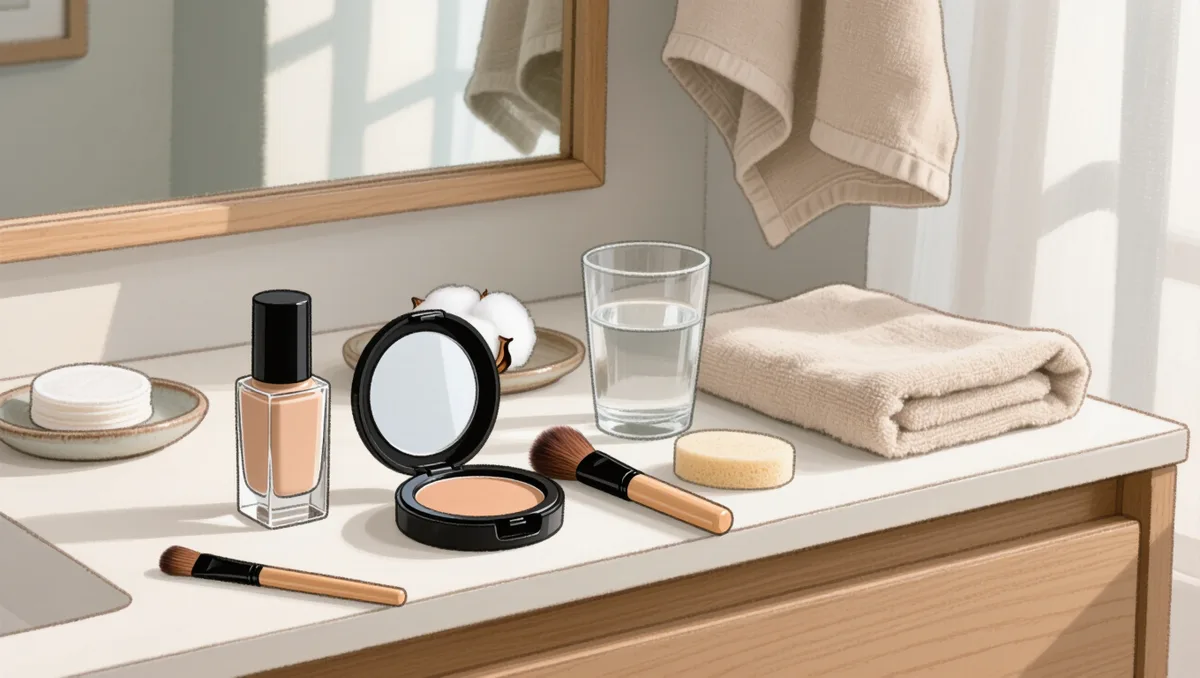
Five products cover it. Anything beyond five is a choice, not a requirement. The core kit: a tinted base (tinted moisturizer or skin tint), a cream blush, mascara, a brow gel or pencil, and a concealer for under-eyes or blemishes. Lip color is a bonus — a tinted balm pulls double duty if your blush is cream and warm-toned.
Why these five? Each fixes the thing people most often want from makeup on a workday: evened-out color, a bit of warmth, defined eyes and brows, and a rested look. Nothing here needs a brush, a mirror with magnification, or more than thirty seconds of blending. Formulas that apply with fingers — creams, balms, liquid tints — cut both application time and cleanup, since there's nothing to wash afterward.
What you can skip on ordinary days: primer (a well-prepped moisturized base does most of its job), powder (unless you're genuinely oily), eyeshadow (mascara and brows carry the eye area alone), and contour. Skipping is not a compromise. It's the reason the routine fits in ten minutes.
What's the fastest order of application?
Work from skincare out to color, in thin layers, and let each step sit while you do the next one. Here is the sequence as a numbered routine:
- Moisturizer and SPF — about 90 seconds. Apply while you pick out clothes or make coffee. Sunscreen needs time to settle before makeup; the layering details are in How to Layer SPF Under Makeup So It Actually Stays.
- Tinted base — about 2 minutes. Dot skin tint or tinted moisturizer across the center of the face and blend outward with fingers. Fingers warm the product, which helps it melt in faster than a brush does. Spot-conceal anything that needs it rather than layering base everywhere.
- Concealer, if needed — about 1 minute. A thin layer under the eyes, patted with a fingertip. Thin layers are what keep it from settling into lines; the technique is covered in How to Stop Concealer Creasing Under the Eyes All Day.
- Cream blush and lips — about 90 seconds. One cream product, tapped onto cheeks and dabbed onto lips. Cream formulas blend into base without a brush, and the placement logic in How to Apply Cream Blush So It Lasts All Day, According to Makeup Artists applies here too.
- Brows and mascara — about 2 minutes. Brush brows up; fill only the sparse spots if you use a pencil. One coat of mascara on the top lashes. This is the step that makes the face look finished even when the base is minimal.
That's roughly eight minutes, with a minute or two of slack. The order matters more than the timing: color goes on over base, and base goes on over skincare. Reversing that is what creates patchiness and pilling, not the products themselves.
Which shortcuts actually work — and which backfire?
Multi-use products are the most reliable shortcut. A cream blush used on cheeks and lips keeps the color story consistent and removes a step. A tinted SPF can replace separate moisturizer and base on very low-key days, though most people need more coverage than a two-in-one gives. Brow gel that adds both tint and hold replaces pencil plus spoolie.
The shortcuts that backfire: skipping moisturizer to save time (makeup grabs onto dry patches and the face looks worse, not faster-done), applying base in one thick layer instead of thin ones (thick layers take longer to blend, not less), and using waterproof mascara daily when you don't need it — it removes harder, and rough removal is what stresses lashes and the delicate eye area. Speed comes from fewer, thinner steps. It doesn't come from skipping prep.
One more honest note: a rushed routine fails most often at the edges — a heavy concealer hand, an unblended blush line. If a step keeps going wrong when you're hurried, it belongs on the skip list, not on the practice list. The everyday face should be the one you can do half-asleep.
How do you make it last through the workday without adding steps?
Longevity in a fast routine comes from product choice, not extra layers. Cream and liquid formulas over well-moisturized skin wear more evenly than powder over dry skin. If you're oily by afternoon, a light powder only on the T-zone — forehead, nose, chin — costs fifteen seconds and does more than powdering the whole face. Blotting papers in a bag handle shine without any product at all.
Setting spray is optional, not mandatory. It earns its place when you have a long day or hot commute; otherwise it's an extra step that adds no visible benefit for most people. The same logic applies to lip liner on an ordinary day — a balm or tint that fades evenly beats a precise lip that needs touch-ups. If heat and humidity are the problem rather than time, the texture and layering choices in How to Make Makeup Last in Summer Heat: Textures, Layering, and Setting go deeper.
What this means in practice: build the ten-minute routine around products that fail gracefully. A base that fades rather than cakes, a blush that softens rather than vanishes, a lip that leaves a stain. Then the routine survives the day without maintenance.
Practical steps to build your own version
Start with the five-product core and adjust once, not daily. If your skin is even and clear, drop the base and keep concealer alone — the routine drops to six or seven minutes. If your brows are full, a clear gel replaces a pencil. If dark circles are your main concern, spend the saved time there with the shade-matching approach in How to Match Concealer to Your Foundation: Lighter, Exact, or Both?
Two habits make the routine faster over time. First, keep the five products together in one pouch or drawer section, so nothing gets hunted down mid-application — a small setup consideration covered in Makeup Vanity Setup Ideas for Small Spaces That Actually Work. Second, clean the tools you do use on a regular schedule; even a fingers-only routine touches mascara wands and spoolies, and hygiene guidance for those is in How to Clean Makeup Brushes — and How Often Dermatologists Say To.
The evidence for a minimal routine isn't a study — it's arithmetic. Five products, thin layers, finger application, and a fixed spot for everything add up to under ten minutes. The routine that works is the one you'll actually do every morning, and simple beats elaborate on ordinary days.