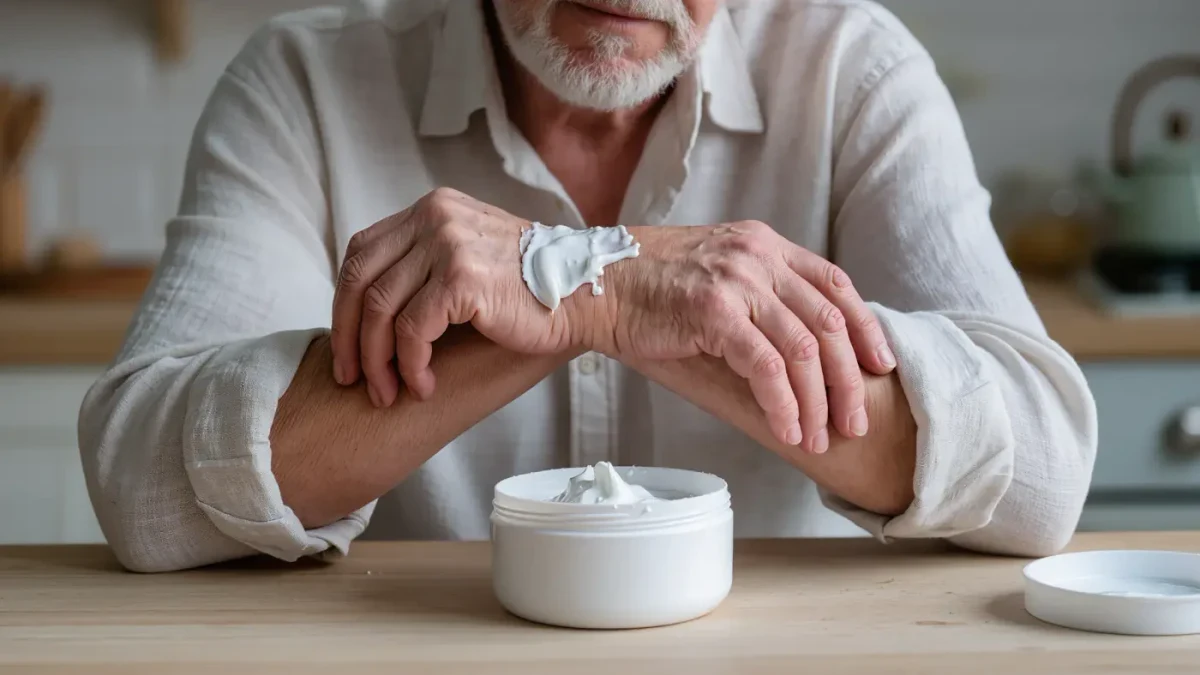
Urea cream works because urea does two jobs at once: below about 10 percent it acts as a humectant that binds water into the outer skin layer, and at 10 to 20 percent it becomes keratolytic, softening the excess keratin that builds up into rough, scaly patches. That dual action is why dermatologists reach for it in very dry skin, keratosis pilaris, and thickened heel skin, where ordinary moisturizers hydrate but never remove the built-up scale. Urea is a natural component of skin's own moisturizing system — it is one of the substances dermatological research has identified in the skin's water-holding complex — so topical formulas replenish a system the body already runs.
Cracked skin that bleeds, weeps, or shows signs of infection needs a clinician, and diagnosed conditions like eczema or psoriasis call for prescribed treatment with urea as a supporting product at most.
What is urea, chemically and in skin?
Urea is a small organic molecule — the same compound blood tests measure as a kidney marker — and in skin it belongs to the natural moisturizing factor, the blend of humectants that keeps the outer layer flexible. Dermatology research on dry-skin disorders, including work on ichthyosis, documented reduced urea levels in affected skin decades ago, which established the logic of replacing it topically. Synthetic urea in creams is chemically identical to the body's own; the molecule simply supplies what the skin is missing.
Why urea differs from glycerin and hyaluronic acid
Glycerin and hyaluronic acid are pure humectants: they hold water but leave keratin buildup alone. Urea at keratolytic strengths breaks the protein bonds holding dead scale together while also drawing moisture in, so it treats the texture problem and the dehydration in one application. For mildly dry arms or legs, any humectant will do; for sandpaper elbows, cracking heels, and keratosis pilaris bumps, the keratolytic function is the point.
Which urea concentration should you choose?
Match the strength to the severity: 5 percent for everyday dryness and maintenance, 10 percent for persistently rough arms, shins, and hands, and 15 to 20 percent for thickened, callused, or scaly skin on heels, elbows, and knees. Formulations above 20 percent and prescription-grade products exist for severe scaling conditions, used under medical supervision. In the European Union, where urea creams are a drugstore staple, the standard retail ladder runs at exactly these steps, per long-standing EMA monograph guidance on urea-containing products for skin use.
| Concentration | Effect | Best for |
|---|---|---|
| 3–5% | Humectant, mild smoothing | Daily dryness, maintenance |
| 10% | Humectant plus light keratolysis | Rough arms, shins, hands |
| 15–20% | Strong keratolytic | Calluses, heels, elbows, keratosis pilaris |
| 20%+ | Prescription territory | Ichthyosis, severe scaling — with a clinician |
How do you apply urea cream for best results?
Apply to clean, slightly damp skin twice daily for active dryness, or once nightly for maintenance, and expect visibly smoother texture in one to two weeks at 10 percent or higher. Dampness matters because the humectant function needs water to bind; applying over bone-dry skin wastes part of the effect. Massage until absorbed, wash hands after treating heels or feet, and pair with socks overnight for heel skin — occlusion pushes the keratolytic work along.
- Wash the area with a gentle, non-stripping cleanser and pat until damp, not dripping.
- Apply a thin layer of urea cream and massage in circles for 30 seconds.
- For heels and feet, add cotton socks before bed.
- Reduce to every other night once the texture normalizes, to maintain without over-thinning.
Does urea help keratosis pilaris?
It is one of the better-supported drugstore options: keratosis pilaris — the rough, goosebump-like bumps on upper arms — is a keratin-plug problem, and 10 to 20 percent urea softens and sheds those plugs while hydrating the surrounding dry skin, per dermatology reviews of the condition. Results take four to six weeks of consistent use, and relapse is the rule rather than the exception, so maintenance two or three nights weekly is the realistic long-term plan. Lactic acid lotions serve the same role for people who dislike urea's texture.
Is urea safe for the face?
Low concentrations are: 3 to 5 percent urea appears in European facial moisturizers aimed at dry, flaky facial skin, and at that strength it behaves as a gentle humectant. Higher concentrations belong on the body, not the face — keratolysis that suits a heel is too aggressive for cheeks. Facial eczema or persistent flaking deserves a dermatologist's diagnosis before self-prescribing any active, urea included.
Urea is the rare ingredient that both adds water and removes what is in the way of smooth skin — which is why the percentage on the tube matters so much.
Does urea cream have side effects?
Mild stinging on cracked or freshly shaved skin is the most common complaint, and it typically fades as the skin improves. Allergy to urea itself is rare in dermatology patch-test data, though cream bases vary and any product that produces lasting burn, redness, or rash should be stopped. Urea should not be applied to broken, weeping, or infected skin, and it is not for use near the eyes — the keratolytic action does not distinguish between callus and delicate tissue.
How does urea compare with lactic acid and salicylic acid for dry skin?
All three are keratolytics with different secondary traits. Lactic acid at 5 to 12 percent softens similarly and adds humectant action but stings more readily; salicylic acid is oil-soluble and best where grease and scale mix, as in scalp conditions; urea is the least irritating keratolytic in most dermatology comparisons and the only one that is also a native component of the skin's moisturizing factor. For very dry skin without acne involvement, urea is usually the first choice, with the acids as alternates — a ranking that matches how European and Japanese drugstore aisles, where urea body care is mainstream, have already voted.