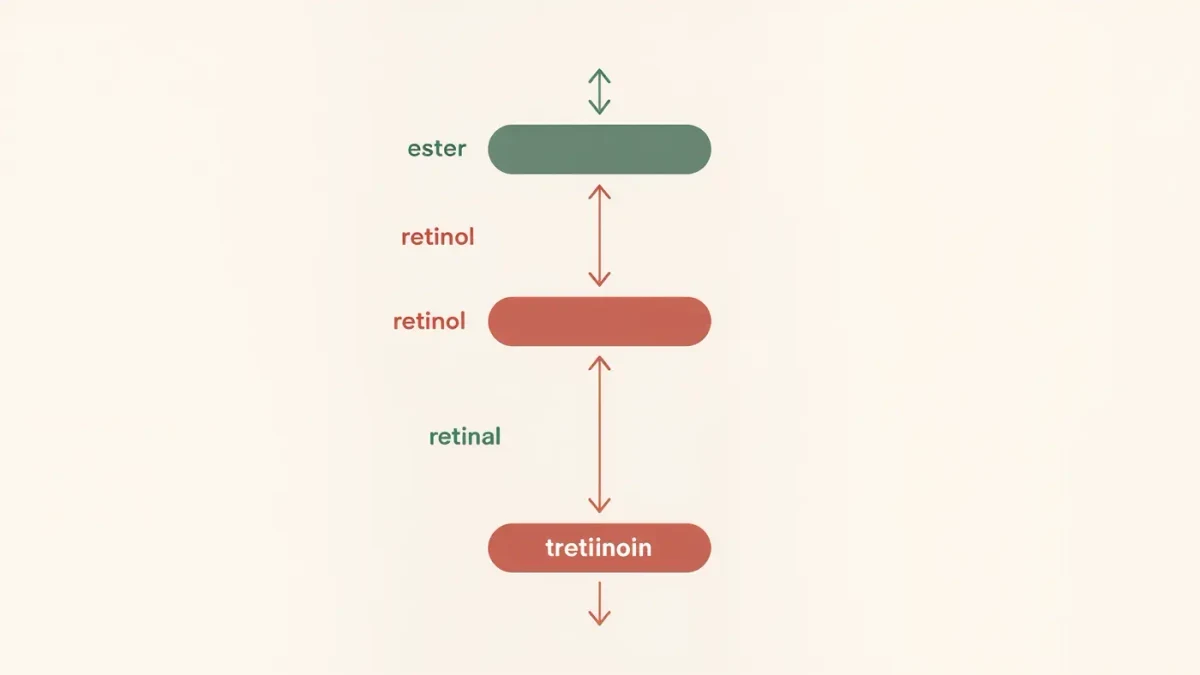
Retinoids differ in strength by how many conversion steps separate them from retinoic acid, the form human skin actually uses. Retinal, also called retinaldehyde, sits one step away and per published comparative research performs closest to prescription-strength results among over-the-counter options. Retinol sits two steps away and remains the category's best-studied non-prescription retinoid. Retinyl palmitate, an ester three steps away, is the weakest of the three — published studies question whether cosmetic-strength doses achieve much at all. Strength and irritation travel together, which is the comparison's real point.
The comparison below attributes claims to published dermatology research and brands' ingredient listings. Prescription retinoids, pregnancy, and diagnosed skin conditions are outside this comparison entirely — those decisions belong to a physician, and medical guidance generally advises avoiding vitamin A derivatives during pregnancy.
What does the conversion chain actually mean?
It means each form pays a toll before it works. Per published pharmacology of vitamin A derivatives, skin enzymes must convert retinal to retinoic acid in one step, retinol in two, and retinyl palmitate in three — palmitate must first be split back into retinol before the rest of the chain runs. Each conversion loses material, which is why equivalent labels do not mean equivalent doses: 0.1 percent retinyl palmitate delivers dramatically less retinoic acid activity than 0.1 percent retinal. Dermatologists note this is also why the milder forms are milder — the conversion bottleneck keeps peak active levels low, trading punch for comfort.
How strong is retinal compared with retinol?
Published head-to-head research favors retinal at equal concentrations. Studies comparing 0.05 to 0.1 percent retinaldehyde against retinol have reported faster and larger improvements in photoaging measures — fine lines and skin texture — with retinal also reaching deeper targets: per published work, retinaldehyde shows activity against Propionibacteria, the bacteria involved in inflammatory acne, which retinol studies have not demonstrated in the same way. The counterweight is cost and stability; brands list retinal in smaller, more expensive formats because the molecule is more fragile, and formulas often add antioxidants to keep it from degrading in the bottle.
Is retinyl palmitate worth buying at all?
Only for a specific, narrow job. Published comparative studies and dermatology reviews place retinyl palmitate far below retinol in biological activity, and several published analyses of sunscreens using it as an additive note its dose there is cosmetic at best. Its legitimate use is entry-level tolerance: skin that cannot manage retinol even twice a week sometimes manages palmitate daily, and brands position it in eye creams for exactly that reason. The ingredient list signals the positioning honestly — palmitate typically appears in the lower half of an INCI list, which per the one percent labeling rule caps its presence at about one percent or less.
Which one causes the least irritation?
The strength order runs backward for comfort: retinyl palmitate is gentlest, retinol sits in the middle, and retinal irritates most often at equal concentration. Published tolerability data from retinaldehyde trials list the expected effects — scaling, dryness, and mild erythema, concentrated in the first weeks. Dermatologists' standard initiation advice applies to every one of the three: start low, start slow, buffer with moisturizer, and use at night, because all retinoids are degraded by sunlight. A pea-sized amount covers the whole face; published guidance on retinoid use consistently attributes over-application, not allergy, to most early dropout.
How should you choose among the three?
Match the form to your skin's tolerance history, then let the concentration do its work. First-time retinoid users usually start with retinol in the 0.2 to 0.3 percent range that published trials used for initiating patients, stepping up as skin adapts. Experienced users chasing photoaging results move to retinal at 0.05 to 0.1 percent, where the comparative research is strongest. Retinyl palmitate is a comfort product, not a treatment product, and treating it as one is the commonest mismatch. Whichever bottle you pick, the brands' own labeling on frequency deserves reading — several now print graduated schedules on the box.
Can retinoids be combined with other actives?
Carefully, and the ingredient list settles most conflicts. Dermatology commentary generally clears niacinamide, azelaic acid, and moisturizing ingredients alongside any of the three retinoids — niacinamide in particular has published data on reducing retinoid-associated irritation. The sharper edges are other exfoliating acids and benzoyl peroxide on the same evening: stacking them multiplies barrier stress, and benzoyl peroxide is an oxidizer, which published formulation commentary notes can degrade retinol on contact if layered undiluted. Splitting schedules — retinoid nights and acid nights — is the standard practical answer, and brands increasingly print compatible-pairing guidance on the box. Spot-treating with benzoyl peroxide in the morning while a retinoid runs at night is a combination dermatologists have long tolerated.
| Factor | Retinyl palmitate | Retinol | Retinal (retinaldehyde) |
|---|---|---|---|
| Steps to retinoic acid | Three | Two | One |
| Relative strength | Weakest of the three | Well-studied baseline | Strongest OTC per comparative trials |
| Typical concentrations | ~1% or less on labels | 0.1–1% | 0.05–0.1% |
| Irritation risk | Lowest | Moderate | Highest at equal dose |
| Stability | Moderate | Moderate; light-sensitive | Fragile; antioxidant-stabilized formulas |
| Published evidence depth | Thin; questioned at cosmetic doses | Extensive | Good head-to-head vs retinol |
| Typical fit | Very reactive skin, eye-area creams | First retinoid, maintenance | Experienced users, photoaging focus |
The verdict the research supports: retinal is the strength pick, retinol is the evidence pick, and retinyl palmitate is a tolerability compromise that should be priced and labeled as one. The best retinoid remains the one skin tolerates long enough to matter.