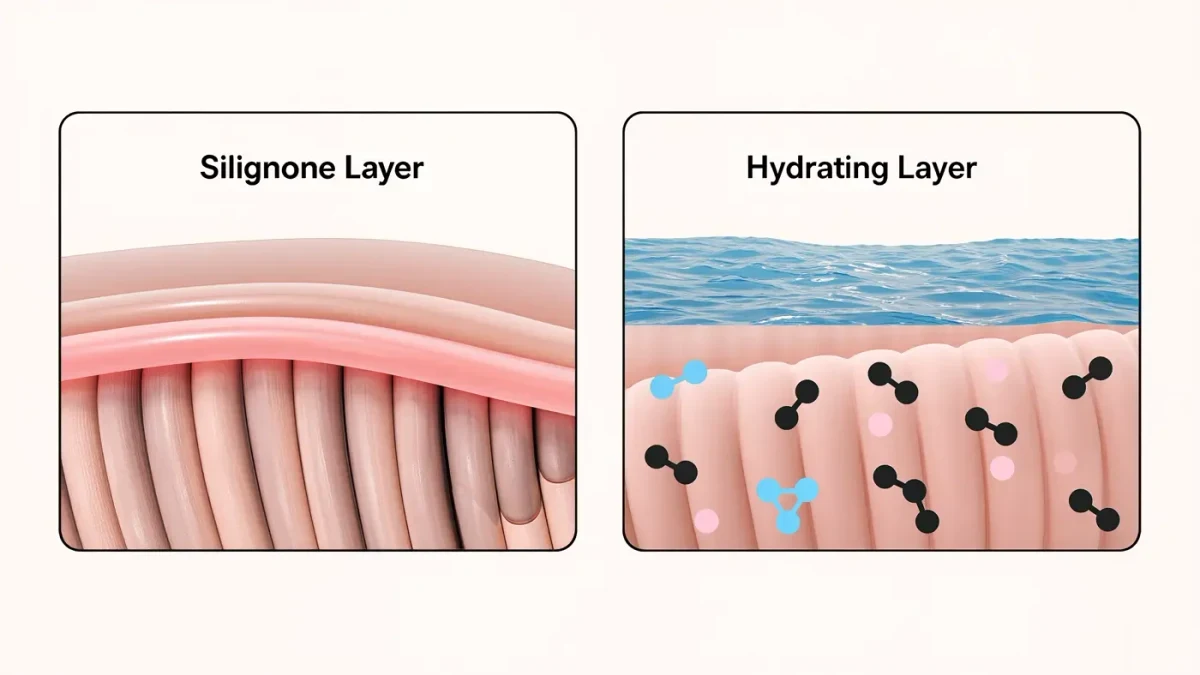
The difference between primer families is visible in the first three ingredients. Silicone-based primers lead with dimethicone, cyclopentasiloxane, or another "-siloxane" that lays down a thin film, fills texture, and gives foundation slip; per brands' ingredient listings, this is the majority of what a smoothing primer contains. Water-based primers lead with aqua and humectants like glycerin, and behave closer to a lightweight moisturizer. The choice is less about which is better and more about which surface your skin and your foundation formula actually need.
What do silicone primers actually do to skin?
They change the surface, not the skin. Per published formulation chemistry, dimethicone and its relatives are inert polymers that sit entirely on top of the stratum corneum, forming a breathable film that evens out micro-texture and slows water loss modestly. That film is why pores and fine lines look optically softer and why makeup glides on afterward. It is also why the effect ends when the primer washes off: dermatologists note silicones do not treat pores or lines, they disguise them for the day. For reactive skin, the film can be a mild benefit — a physical buffer between skin and pigment — though the full ingredient list, not the silicone, predicts irritation.
What does a water-based primer deliver instead?
Hydration first, grip second. Water-based formulas list aqua, glycerin, panthenol, and often film-forming polymers that help makeup adhere without a noticeable layer; brands position them for normal to dry skin and for sheer, skin-like finishes. Published formulation commentary treats this class as a moisturizer with mild adhesive properties rather than a surface corrector, which explains its limits: a water-based primer will not fill a pore or blur a scar, because nothing in it creates that fill. Its advantage is compatibility — watery, hydrating foundation formulas bond to it cleanly, and it adds none of the slip that can make sheer foundations slide off oily skin by afternoon.
Does silicone under water-based foundation really pill?
Makeup artists' consistent guidance says mismatch is real, but the direction is specific: the trouble arrives when a water-based product sits on top of a fresh silicone film, where it can bead, ball, or refuse to spread — the phenomenon wearers call pilling. The reverse order is more forgiving, since a thin silicone layer over a hydrated base usually settles. Per brands' own usage directions, silicone primers ask for a minute of setting time before foundation goes on, which alone resolves many complaints blamed on chemistry. The practical reading: check both formulas' bases — silicones end in -cone, -conol, or -siloxane — and stack closest to closest.
Which primer family suits oily skin?
Silicone, on balance, and the labels say why. Oil-control primers are overwhelmingly silicone-matrix formulas: dimethicone film reduces the shine transfer that breaks down makeup, and listed Mattifying 2.0-era additions like silica powders absorb sebum on top of it. Dermatologists add one caveat that matters for acne-prone readers — heavy silicone films combined with inadequate cleansing can trap the day's sebum against skin overnight, so removal discipline matters more than the primer itself. Water-based primers with mattifying powders exist for oily skin too, but per published comparisons of wear tests run by brands, they tend to maintain a natural finish rather than the flat, blurred one silicone delivers.
How do you identify the base in under a minute?
Read the ingredient list, top to bottom, for the ending letters. Per standard labeling, ingredients are listed in descending concentration, so the first five names settle the question: a run of dimethicone, cyclopentasiloxane, or trimethylsiloxysilicate marks a silicone primer; aqua followed by glycerin or butylene glycol marks a water-based one; a long silicone chain after water signals a hybrid, which is what most "hydrating blur" primers are. Hybrids are not a dodge — they are often the best answer for combination skin — but knowing what you are holding turns primer shopping from a texture gamble into a formula decision.
How much should a good primer cost?
Fewer dollars than the category suggests, per the ingredient lists. Dimethicone and cyclopentasiloxane are commodity polymers, and published formulation commentary has long noted that a smoothing primer is one of the cheapest products in makeup to manufacture; what varies sharply at the luxury tier is the packaging, the fragrance, and the marketing around a proprietary-sounding blur complex. Budget formulas concentrate their spending on the polymer itself, which is the part that works. The honest price comparison is to match the polymer percentage implied by the INCI order and treat claims of skincare benefits in a primer as bonus texture, not value. If a thirty-dollar blur and a twelve-dollar blur both open with dimethicone, the lists describe two very similar products.
| Factor | Silicone-based primer | Water-based primer |
|---|---|---|
| Lead ingredients | Dimethicone, cyclopentasiloxane | Aqua, glycerin, butylene glycol |
| Mechanism | Surface film fills and blurs | Hydrates; mild adhesive grip |
| Best under | Silicone-heavy, fuller-coverage foundations | Water-based, sheer, skin-tint formulas |
| Best for skin | Oily, textured, large-pore concerns | Dry, dehydrated, natural-finish looks |
| Wear behavior | Blur holds; can look flat if over-applied | Skin-like; less shine control |
| Common complaint | Pilling under water-based makeup | No blurring effect at all |
| Removal need | Thorough evening cleanse | Standard cleanse |
The verdict the ingredient lists support: silicones are surface engineers and water formulas are hydration with grip, and the primer that wins is the one whose base matches both your foundation's base and your skin's oil output. Neither family is a treatment, and neither claims to be once the label is read honestly.