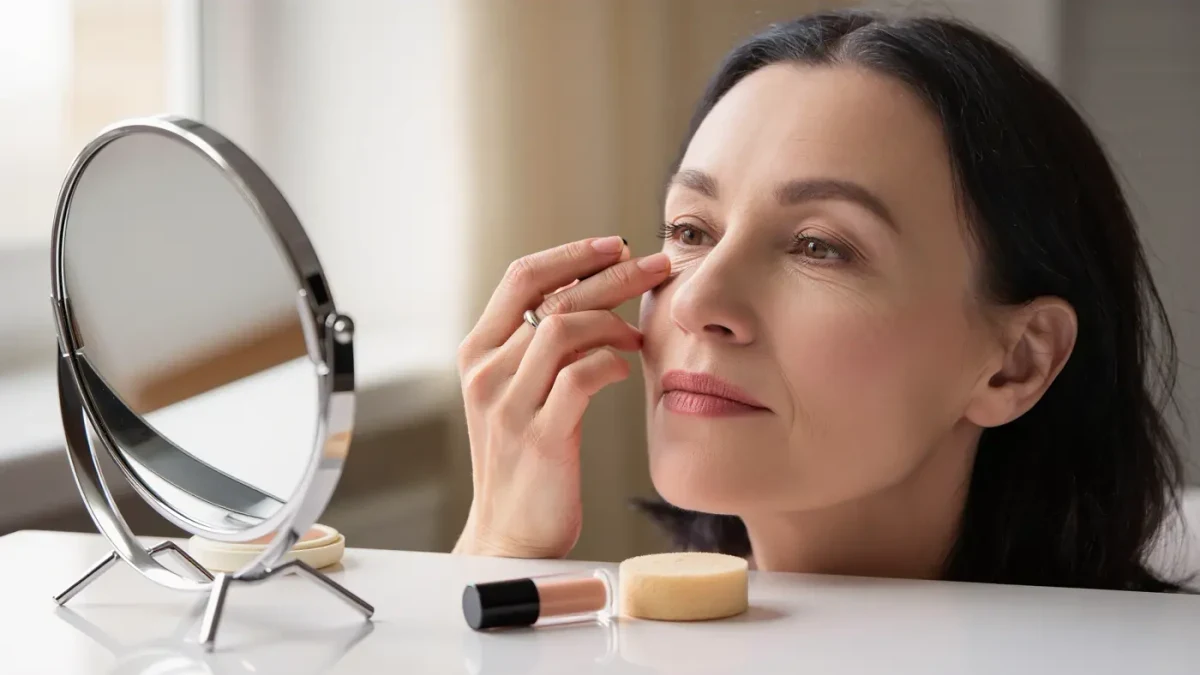
Concealer should match your foundation exactly on blemishes and redness, and sit one half-step to one full step lighter under the eyes — two different jobs, two different matches, usually two shades. A single all-purpose shade is the main reason concealer either disappears into a pimple you wanted hidden or leaves a pale gray ring under the eyes. Makeup artists pick by zone: coverage where you want camouflage, subtle lift where you want brightness.
Persistent darkness under the eyes can have medical causes — allergies, anemia, thyroid issues — that makeup only covers, so a new or worsening discoloration is a reason to see a doctor, not just a counter. The technique below is the standard method working artists teach, organized by zone and formula.
Should under-eye concealer be lighter than your foundation?
Slightly, and only slightly. The classic artist rule is one half-step lighter in depth than your foundation, in the same undertone family — enough to catch light and create the look of lift, not enough to read as a pale crescent. The old advice to go two or three shades lighter came from heavy-coverage camera makeup and fails in daylight: it photographs gray and emphasizes texture. Modern artist guidance is consistent on this — brightness should come from where the concealer sits, not how pale it is. Some artists add that if your under-eye area is genuinely darker than the rest of your face, you correct with a peach or orange color corrector first, then apply a same-depth concealer; the lightness comes from the correction layer, not a whiter concealer.
Should blemish concealer match your foundation exactly?
Yes — depth and undertone both. A blemish is a raised or discolored spot you want to erase, and the only shade that erases is one that matches the surrounding skin precisely. Anything lighter draws the eye to the spot you were hiding, which is the opposite of the goal. Apply with a small dense brush, press the pigment into the spot rather than wiping, and tap the edges with a fingertip until the boundary disappears. Set with a fine layer of translucent powder, pressed with a puff rather than swept, so the coverage holds.
Does the undertone rule change by zone?
It does, and this is where most mismatched concealers go wrong. Under the eyes, darkness is usually blue, purple, or brown-toned; a concealer in your skin's undertone layered straight over blue darkness can look gray. The standard artist fix is correction first: peach or orange correctors cancel blue and purple darkness, red-toned correctors cancel green and olive shadows, and deeper skin tones use orange or red-orange. After correction, a concealer in your true undertone restores skin color. On blemishes and redness around the nose, skip correction entirely — a green corrector under a pimple adds a layer that can lift and look ashy; exact-match concealer alone does the job.
| Zone | Depth vs foundation | Undertone | Formula family |
|---|---|---|---|
| Under-eyes | 0.5–1 step lighter | True undertone over peach corrector | Luminous, flexible, medium coverage |
| Blemishes | Exact | Exact | Dense, matte, high coverage |
| Redness (nose, cheeks) | Exact | Exact | Buildable cream |
| Cutting crease / brightening | 1–2 steps lighter | Neutral or warmer | Firm, opaque, minimal slip |
Does concealer formula need to match the foundation formula?
Not exactly, but the chemistry should cooperate. The widely taught rule: cream over cream, and never water over silicone at the same layer. If your foundation is silicone-based (dimethicone high in the ingredient list, per the brand's listing), a water-based concealer on top can bead and separate within an hour. The safer sequencing is lighter texture under denser: a fluid concealer under a cream foundation rarely works, while a cream concealer over a set fluid foundation holds. Check both labels — brands list their base ingredients, and the first five tell you the system.
Why does under-eye concealer crease and cake?
Because the under-eye area moves constantly and holds less oil to bind pigment, so any excess product collects in the fine lines as the skin folds. The artist sequence that prevents it is short: hydrate first and let the eye cream absorb fully — residual slip is what causes pilling; apply a thin layer with a warm fingertip or small sponge rather than a full sweep from the wand; immediately press (not sweep) translucent powder over it with a puff; and stop at one layer. If caking still shows, the usual culprit is too much powder, not too much concealer — powder is a lock, not a second coat. Setting sprays have limited effect under the eyes, where the skin's movement defeats most films, per makeup artists' guidance.
How do you test concealer shades in the store?
Not on the hand — wrist skin has neither the darkness of the under-eye nor the texture of the cheek. Swatch candidates directly in the target zone: along the under-eye for brightness shades, on a blemish or the inner cheek for exact-match shades. Give it five minutes, then check in daylight near a window. The right under-eye shade will look slightly bright but still skin-colored; the right blemish shade will vanish. If the store's lighting is warm and dim — common at counters — treat the daylight check as final and the in-store swatch as preliminary.
Can one concealer really not do both jobs?
Some can, within a compromise. A buildable medium-coverage concealer in your exact depth can be sheered out under the eyes and built up on blemishes — the single-shade approach that works best for people with mild darkness and small imperfections. What one shade cannot do is deliver true brightness under the eyes, because an exact-depth concealer, however buildable, cannot be lighter than itself. If dark circles are your main concern, the two-shade system — corrector plus lighter concealer — remains the method makeup artists reach for; if blemishes are your main concern, a single exact-match shade plus powder covers the whole map.