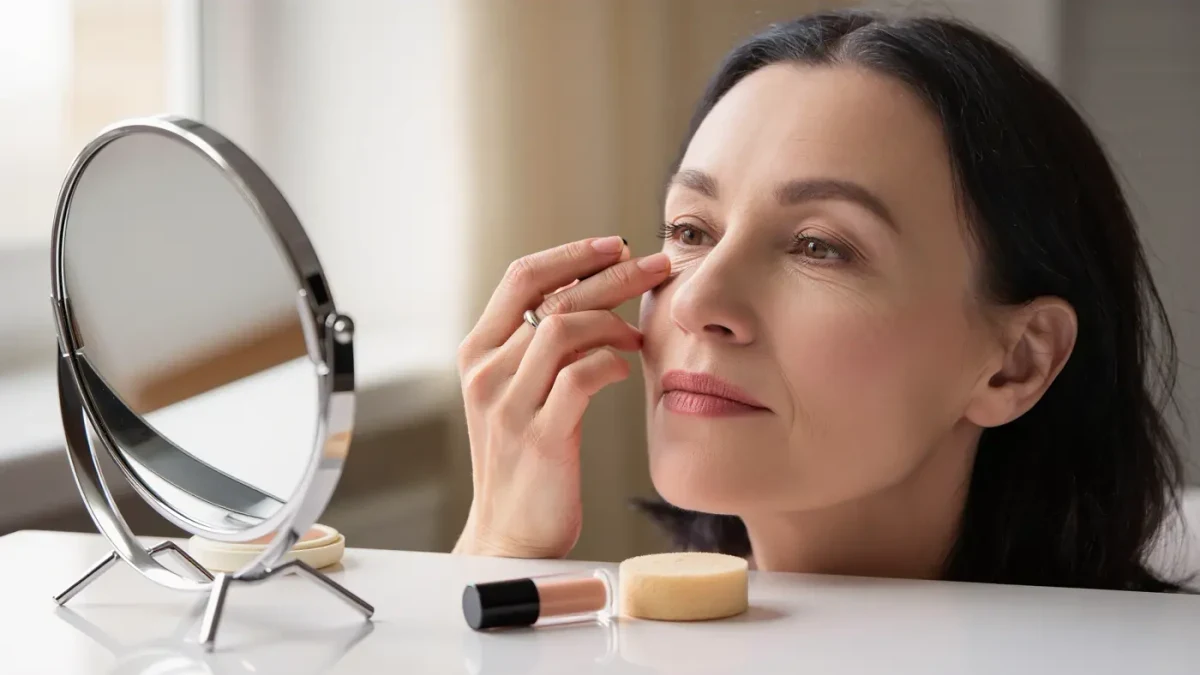
Cakey under-eyes come from three fixable things: too much product in one pass, concealer gripping dry or un-prepped skin, and heavy-handed powder. The fix is the sequence makeup artists use on every mature or dry client: hydrate the under-eye and let it absorb, apply a thin layer of concealer with a fingertip or small sponge, and press — never sweep — a minimal amount of translucent powder over it. A half-step-lighter concealer in your true undertone, over a peach corrector if your darkness is blue or purple, does the color work; the layer discipline does the texture work.
BEAUTY RING publishes information, not cosmetic or medical advice. Dark circles have several distinct causes — thin skin showing vessels, pigment, shadow from eye-bag anatomy, allergies, and sleep debt among them — and makeup covers them rather than treats them. New, worsening, or one-sided darkness deserves a doctor's look before it gets another layer of concealer. The technique below, as working artists teach it, handles the covering part.
Why does under-eye concealer cake in the first place?
Because the under-eye is the worst possible venue for heavy makeup: the skin there is thin, moves constantly, produces little of the oil that helps product blend elsewhere, and has fine lines that catch excess. When concealer goes on thick, the mobile skin folds push it into those lines within hours, and the excess dries as visible texture. Powder makes it worse when over-applied, because powder is hydrophobic — layered on thick, it absorbs the moisture the concealer needs to stay flexible, and the whole film cracks. So caking is not a bad-luck formula issue; it is the predictable result of quantity and prep, which is why the fix is behavioral before it is a shopping decision.
How should you prep the under-eye before concealer?
Hydrate, then wait — the wait is the step people skip and the one that matters most. Apply eye cream or a hydrating serum to clean under-eyes, then give it several minutes to absorb; artists routinely do eyes last or do other steps in between for exactly this reason. Residual wet cream under concealer causes two failures: the product grabs in patches as it mixes with the wet layer, and it pills into little rolls as you blend. The target state is skin that feels soft but dry to a light touch. On very dry under-eyes, a slightly richer cream at night does more for morning texture than any primer — the dermatologists' standard advice for the eye area is hydration and sun protection, not a shelf of specialty products.
Which concealer texture avoids caking best?
Flexible, medium-coverage formulas beat dense, matte ones under the eyes. A luminous or skin-like concealer in a fluid or light cream texture moves with expression instead of cracking, and because it is buildable you can correct coverage with a second thin pass instead of one thick coat. The fullest-coverage concealers are engineered for blemishes — staying put on still skin — and under the eyes that same rigidity reads as crepe. Application tools change the math: a warm fingertip melts the product into skin, a small damp sponge presses it without dragging, and the doe-foot wand alone tends to over-deliver — artists advise dotting the wand's excess onto the hand first and applying only what remains.
Does the shade matter for caking, or just color?
It matters for both, and the color rules come first. One half-step lighter than your foundation, in your true undertone, gives lift without a gray crescent; if darkness is blue or purple, a peach or orange corrector under the concealer cancels it, letting the concealer itself stay thin — correction does the color work so thickness does not have to. Deeper skin tones use orange or red-orange correctors to the same effect. Depth then interacts with texture: a concealer chosen far too light usually gets applied heavier, because the wearer keeps trying to blend away the contrast, and that extra product is what cakes. The right shade lets you use the least product possible, which is the entire anti-caking strategy.
| Step | Do | Skip |
|---|---|---|
| Prep | Eye cream, fully absorbed | Fresh wet cream under concealer |
| Correct | Peach/orange thin layer over darkness only | Corrector across the whole under-eye |
| Conceal | Thin layer, fingertip or small sponge, half-step lighter | Wand-to-eye direct, thick coat |
| Set | Whisper of powder, pressed with puff | Swept layers of loose powder |
Should you set under-eye concealer with powder at all?
Yes, but the dose is a whisper, not a dusting, and the tool matters more than the amount. Press a small puff loaded with minimal translucent powder against the concealer — pressing deposits a thin, even lock layer; sweeping a big brush drags product and leaves a thick film that cracks by afternoon. Artists who work with dry or mature skin sometimes set only the inner corner and the crease-prone fold, leaving the outer under-eye bare, or skip powder entirely on days spent indoors. The trade-off is explicit: powder buys hours of wear and costs luminosity, so spend it where your day requires it.
Why does concealer crease even when applied thinly?
Then the causes are usually below or above the product. Below: insufficient hydration, so the concealer grips dry micro-texture, or too-rich cream not yet absorbed, so it slides and gathers. Above: powder excess drying the film out. Product choice covers the rest — a thick matte formula will crease on some under-eyes no matter how thinly it is applied, which is the case for switching to a flexible texture rather than refining technique. One further factor is anatomical: deeper tear troughs cast real shadows that no amount of concealer fills, and artists address those with a thin brightening layer in the trough itself rather than piling concealer on the shadow line.
What about eye bags, hollows, and puffiness — can concealer fix those?
Partially, with an honest limit. Concealers can brighten pigment and optically soften shadows, but they cannot fill or deflate anything — a puffy morning bag or a deep hollow is anatomy, and product layered thickly over it amplifies the texture it is meant to hide. The artist approaches that work: for shadows cast by bags, place a thin brightening concealer on the shadow beneath the bag, not on the bag; for hollow tear troughs, a small amount of a light-reflecting concealer in the trough, blended upward. Cold compresses and sleep position help morning puffiness, per general dermatology guidance, while persistent bags are a cosmetic-procedure conversation, not a makeup one. The winning move, again, is restraint: two thin layers outlast one heavy one on every texture, and the reader who masters the thin pass never needs the thick one.