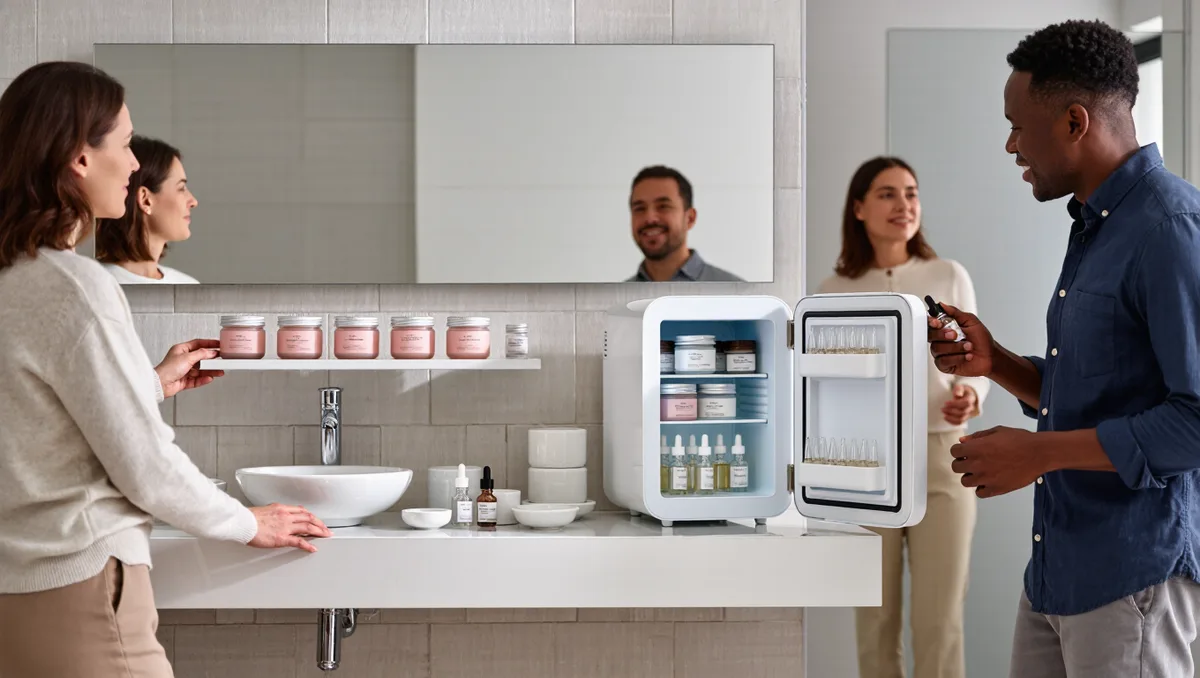
A skincare fridge keeps products at a cool, steady temperature, and it does two things well: it makes application feel soothing, and it can help some fragile formulas hold their stability a little longer. What it does not do is dramatically extend shelf life across the board, and it is not a substitute for the printed period-after-opening date on the packaging.
The honest version is this: a fridge is a nice-to-have, not a need. If you store products in a cool, dry cabinet away from direct sunlight, you have already handled the biggest enemies of a formula — heat, light, and humidity. The fridge adds comfort and a modest stability benefit for a few specific ingredient types, and it adds nothing for others.
Before deciding whether the trend earns a spot on your counter, it helps to know what a skincare routine actually asks of storage — and that starts with what breaks a formula down in the first place.
Why do skincare products go bad in the first place?
Three things degrade a formula: heat, light, and air exposure. Heat speeds up chemical reactions, which is why a product left on a sunny windowsill can separate, darken, or lose potency faster than one kept in a cool drawer. Light does the same for light-sensitive ingredients. Air matters because every time you open a jar, oxygen and fingers introduce contamination risk.
Manufacturers design formulas with these enemies in mind. Preservative systems, opaque packaging, airless pumps, and stabilised ingredient forms all exist to buy a product time. That is why the period-after-opening symbol — the little open jar icon with a number of months on it — is printed on nearly every product. That number assumes reasonable storage, not a hot car or a steamy shelf above the shower.
A fridge attacks two of the three enemies. It lowers the temperature and, if the product stays sealed in its box or an opaque container, it lowers light exposure too. It does nothing about air exposure, which is why a jar you dip into daily will still hit its limit whether it lives on the counter or on the fridge shelf.
Does chilling products actually extend their shelf life?
Sometimes, modestly. Cooling slows chemical reactions, so a heat-sensitive formula kept cold can stay closer to its original state for longer than the same product sitting in a warm bathroom. That is a real effect — but it is a slowdown, not a preservation system. Cold does not sterilise anything, and it does not neutralise contamination from dirty fingers or an old applicator.
The products most likely to benefit are ones with notoriously fragile actives. Vitamin C is the classic case: certain forms of it oxidise faster when exposed to heat, light, and air, turning an orange or brown tint that signals degradation. If you already follow the storage guidance on a vitamin C serum — cool, dark, tightly closed — a fridge is a reasonable extension of that habit, not a magic fix.
Where the fridge genuinely earns nothing: most cleansers, basic moisturisers, and well-preserved products in airless pumps. Their formulas are built to sit at room temperature for their full usable life. Chilling them changes nothing except your electricity bill.
Can a cold product soothe your skin?
Yes, and this is the part of the trend with the least controversy. Cool temperature constricts blood vessels at the surface and reduces the feeling of puffiness, which is why cold spoons and chilled gel patches have been a morning trick for decades. A chilled eye cream or gel moisturiser delivers the same sensation.
The relief is real but temporary. Cold can feel calming on freshly exfoliated skin or after a hot shower, and a cool gel on sun-exposed skin is a comfort measure, not a treatment. If your skin is reactive, a chilled product can also reduce the sting of certain actives on application — a comfort effect, not a change in how the ingredient works.
One caution belongs here. If a moisturiser stings regularly at any temperature, that is a formula or barrier problem worth investigating, not something to chill your way around. Our piece on why your moisturizer stings — and when to stop using it covers when stinging is a signal rather than a sensation.
What this means for your routine
Our analysis: the fridge trend is mostly comfort with a side of stability, and the comfort alone is a fair reason to own one. If a chilled morning routine makes you consistent with sunscreen and moisturiser, that consistency does more for your skin than the temperature ever will. Enjoyable routines get followed; joyless ones get abandoned.
Practical steps, in order of value:
- Store everything in a cool, dry place away from sunlight first. A drawer beats a windowsill, and a fridge beats a hot bathroom.
- Refrigerate the fragile few: vitamin C serums, certain antioxidant blends, and anything the packaging explicitly tells you to keep cool.
- Keep jars and anything you dip fingers into out of shared fridge shelves with food, and never freeze a product. Freezing can crack emulsions and permanently change texture.
- Let nothing override the period-after-opening date. A chilled product that smells off, has changed colour, or has separated is done.
- If you buy a fridge, pick one that holds a steady cool temperature rather than a freezer-cold one. You want cellar-cold, not ice-cold.
If you are trimming your routine instead of expanding your storage, the principles in how to build a minimalist skincare routine you will actually keep apply here too: every addition should earn its place. And if you want to know whether a formula is fragile before deciding where it lives, learning to read an INCI list on skincare packaging tells you more than any trend video does. We covered a connected angle in How to Build a Minimalist Skincare Routine You Will Actually Keep.
The bottom line on the skincare fridge trend
A skincare fridge is helpful for comfort and mildly helpful for a handful of heat-sensitive formulas. It is hype when it is sold as a shelf-life solution or a skin transformation. The evidence-supported core is small but real: cold slows degradation reactions, cold feels good on puffy or irritated skin, and neither effect replaces clean handling, sealed packaging, or the expiry date printed on the box. Spend on the fridge only after you have spent on the basics — and if your basics are already solid, the fridge is a pleasant upgrade rather than a necessary one.