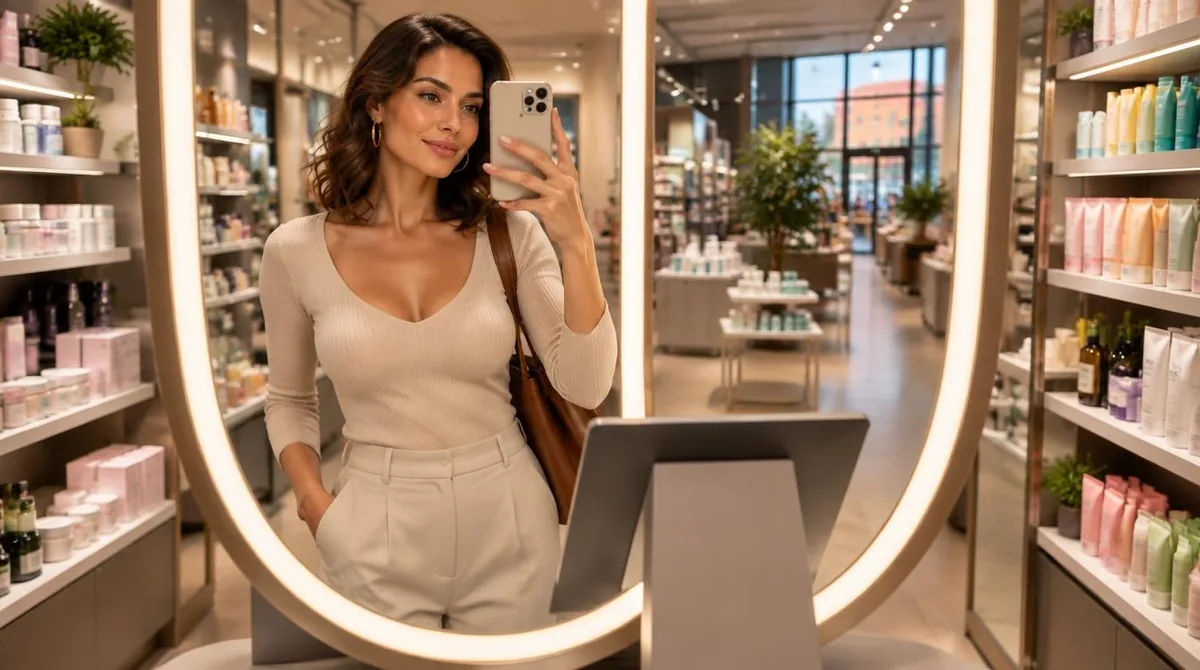
Shoppers at an Italian hypermarket can now get a personalised skincare routine from a selfie, for free, with no appointment. Dermaself, a Milan-based beauty tech company, has installed its AI skin analysis smart mirror in the parapharmacy area of Ipercoop Baragalla in Reggio Emilia, working with the retailer Coop Alleanza 3.0. The service went live on 19 November 2026, according to Cosmetics Business.
The location matters as much as the technology. Mass retail is Italy's largest cosmetics channel: shoppers spent €4.49 billion there in 2024, per the Centro Studi of Cosmetica Italia, ahead of €2.77 billion in perfumeries and €2.22 billion in pharmacies. Those stores are also where purchases sometimes happen without the shopper knowing what a product contains or whether it suits their skin. The smart mirror is Dermaself's answer to that gap, and it is a notable development for anyone who reads skincare labels rather than brand names.
How does the smart mirror work?
The process is built to fit into a weekly shop. A shopper takes a selfie at the free-standing mirror, which has a built-in tablet, and answers a short skin questionnaire. The AI then analyses visible skin features from the photo. Those results are matched against the ingredient lists of the skincare products stocked at Ipercoop Baragalla, and the shopper receives a morning and evening routine, also sent by email along with a store offer. The whole service is self-service and free. We covered a connected angle in Duty-Free Beauty: How Airport Prices Work and When They Save Money.
Before the analysis starts, shoppers are told the results are generated by AI, are for cosmetic and informational purposes, and are not a medical or dermatological diagnosis. That framing matters, because the mirror reads visible features only: blemishes, wrinkles, dark spots, pores, dryness, oiliness, dark circles, loss of firmness and redness.
What is the technology actually based on?
Dermaself's skin taxonomy, the classification of skin features the AI recognises, was developed with Derming, an independent clinical research institute in Monza with more than 30 years of dermatological research. Per Cosmetics Business, it was validated on more than 100,000 clinical images reviewed by board-certified dermatologists. The underlying technique is computer vision, the branch of artificial intelligence that interprets images. Those are the company's own claims about its system, so they describe Dermaself's documentation rather than an independent test of the mirror in the aisle.
Why recommend by ingredient instead of brand?
A supermarket skincare aisle is multi-brand, and products with different formulas often sit side by side at similar prices. Starting from ingredients means the recommendation rests on what is inside each product rather than the name on the front. Dermaself reads the INCI list, the standardised ingredient list printed on every cosmetic sold in the EU, of every product in the store's range, then selects the formulas that match the shopper's skin needs.
For the retailer, ingredient-based matching also means the advice is built on its own assortment rather than a single brand's catalogue. That is the structural difference from the usual counter experience, where advice often comes from one brand's representative.
Has this been done in supermarkets before?
Yes, though differently. In 2022, L'Oréal Paris and Garnier brought skincare consultations based on ModiFace, the L'Oréal-owned AI and augmented reality technology, to more than 100 Sainsbury's supermarkets in the UK. The Ipercoop Baragalla project differs in how the service is delivered, which products are recommended and how recommendations are made, according to Cosmetics Business.
The Sainsbury's model routed shoppers toward brands owned by one company. The Italian setup recommends across the store's whole range. Readers tracking how the beauty business reorganises itself around data can compare this with what beauty mergers mean for the makeup bag, another case of corporate structure reaching the shelf. For related coverage, see Beauty Mergers Shoppers — What Beauty Mergers Mean for Your Makeup Bag: A Shopper Guide.
What does the retailer learn?
Each analysis gives one shopper a routine. Taken together, the analyses form a picture of the store's customer base. Coop Alleanza 3.0 receives only aggregated, anonymised statistics, such as the most common skin needs and the products recommended most often, from which no individual shopper can be identified. The retailer has no access to shoppers' personal data. Over time, those statistics can inform assortment, shelf layout and in-store communication.
That feedback loop is the quiet story here. A retailer that knows which skin needs its customers actually have can stock differently. It is the same logic behind how licensing and ownership shape what sits on shelves, just driven by shopper data instead of contracts.
What could this mean for mass-market beauty?
Personalised skincare advice could become available at any moment of the shopping trip, in the channel where most cosmetics are bought. Dermaself positions the mirror as a tool that adds to store staff rather than replacing them, letting shoppers use it whenever they want to understand which products suit their skin, without needing to become experts in ingredient lists.
What remains unknown is uptake. The coming months at Ipercoop Baragalla will show how shoppers use the service and what the store learns from it. Whether a selfie in a supermarket aisle changes what ends up in the basket is the question the data will answer.