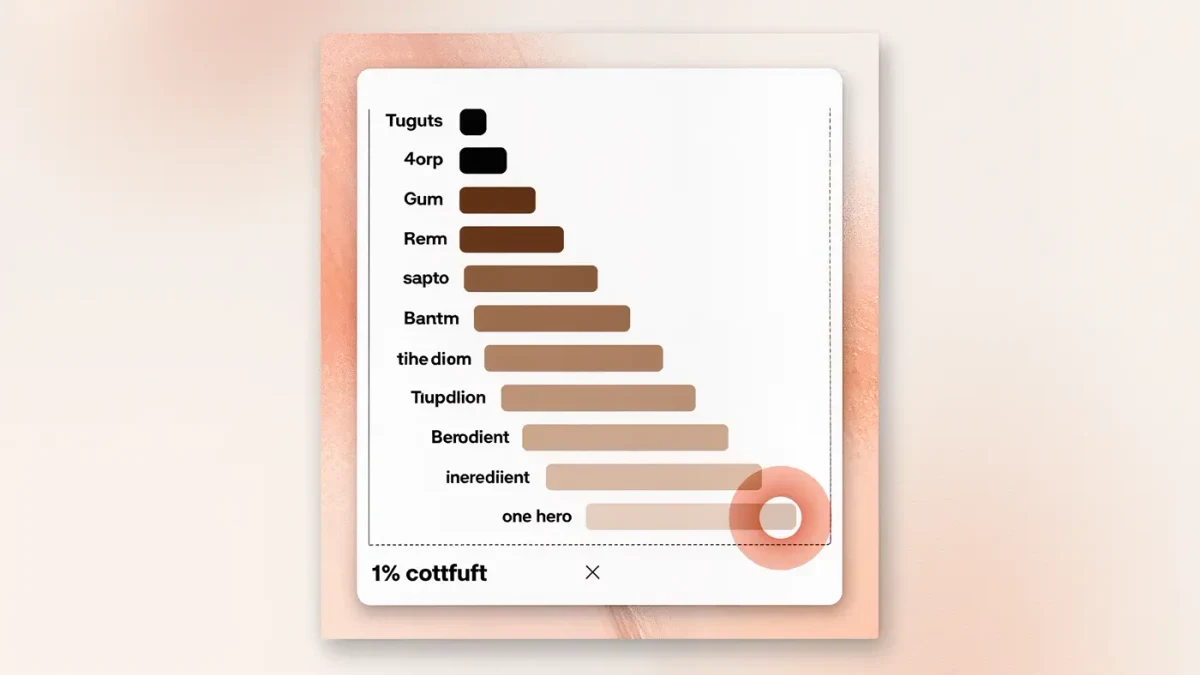
Reading an INCI list starts with the order rule: in the United States and European Union alike, ingredients present at more than one percent must be listed in descending order of concentration, while ingredients at one percent or below may be listed in any sequence after them. That single regulation — standard under U.S. FDA cosmetic labeling rules and EU Regulation 1223/2009 — turns the label into a rough concentration map. If niacinamide sits fifth among eight ingredients, the formula contains a functional dose; if it appears after the preservative phenoxyethanol, you are looking at fairy dust. Neither placement is illegal. Only one is what the marketing implies.
This article publishes information, not medical or legal advice. Labeling rules differ by country, and a suspected reaction to a product belongs with a dermatologist or allergist, not with a self-diagnosis from a database.
What does INCI stand for, and why do names look like chemistry class?
INCI means International Nomenclature of Cosmetic Ingredients — a standardized naming system so a single ingredient carries the same name in New York and Milan. Tocopherol is vitamin E, ascorbic acid is vitamin C, and butylene glycol is a common solvent humectant; the chemical names exist because trade names and translation would otherwise make cross-border comparison impossible. Ingredients with botanical origins appear as Latin binomials — Butyrospermum parkii is shea butter — sometimes with the common name in parentheses.
The five positions that matter most
Most of a formula's behavior is decided by the first five to eight entries, which together usually account for the bulk of the product by weight. Water — "aqua" or "eau" — leads in almost every emulsion. What follows immediately after water tells you the product's real character: a second humectant like glycerin promises a hydrating gel; a long silicone list promises slip and film; a pile of emollient oils promises an occlusive cream.
How can you estimate concentration from the order?
Use the one-percent cutoff as an anchor. Preservatives typically sit at 0.5 to 1 percent by regulation, so phenoxyethanol marks the approximate one-percent line: ingredients listed before it exceed one percent; those after it may be anywhere below that. Dermatologist-lineage labeling analyses use exactly this trick to sanity-check marketing claims. Three readable signals follow:
- An active listed after the preservative is present below roughly 1 percent — real, but rarely at studied doses.
- A "key ingredient" placed tenth on a list of forty is a marketing placement, not a formulation decision.
- Fragrance or parfum listed early is legal but often signals the fragrance load is high enough to matter for sensitive skin.
Are ingredient lists in descending order everywhere?
Almost, with the same one-percent carve-out. The FDA's cosmetic labeling regulations and the EU's Regulation 1223/2009 both require descending order above one percent; the EU additionally requires allergenic fragrance components to be individually listed above 0.001 percent in leave-on products, which is why EU-sold labels run longer. Colorants and ingredients under one percent are the deliberate exceptions — anything below the threshold can shuffle for competitive-concealment reasons, a practice the industry calls fairy-dusting.
| Position on label | Approximate concentration | What it tells you |
|---|---|---|
| 1st (usually aqua) | Highest, often 60–80% | Product base |
| 2nd–5th | Roughly 1–10% each | The formula's real texture and function |
| Around the preservative | ≈1% line | Anchor for everything after it |
| After the preservative | ≤1%, any order | Actives at trace-to-low doses |
Which label claims are marketing, and which mean something?
"Dermatologist-tested," "clean," "non-toxic," and "hypoallergenic" have no uniform legal definition in U.S. cosmetics regulation — the FDA's own materials note the term hypoallergenic has no regulatory meaning. Claims with teeth are those tied to defined standards: "fragrance-free" in a responsible formula means no added parfum, "SPF 30" is a tested rating, and "alcohol-free" has a defined meaning for consumers avoiding ethanol. The ingredient list, not the front of the package, is the only part of the label legally required to describe what is inside.
How do you spot fairy-dusting?
Check where the hero ingredient sits relative to the preservative and to the thickener cluster (ingredients like carbomer, xanthan gum, and acrylates copolymers usually land below one percent). A serum whose lead active appears after xanthan gum is dosed at a fraction of the levels used in published trials of that active. This does not make the product useless — but it predicts a difference from the study results the marketing borrows.
How long should an INCI list be?
Length itself is neutral: a sunscreen legitimately needs UV filters, antioxidants, stabilizers, and emulsifiers, and may run 30-plus ingredients. What deserves attention is density in specific zones — a long run of film-forming silicones in a "hydrating" serum, or five different fragrance-adjacent botanical extracts in a product for reactive skin. Compare lists within a category rather than across categories, and prioritize the position of the one or two actives the product exists to deliver.
The front label sells the formula; the back label is the formula.
Can you check safety with an ingredient database?
Databases help with identification more than with safety verdicts. The EU's CosIng database and the FDA's ingredient resources let you confirm what a name is; hazard-scoring apps typically grade raw-material hazard data without accounting for concentration or formulation, which is why a preservative used safely at 0.8 percent can score like a toxin. For allergy management the reliable tool is patch testing by a dermatologist, since reactions are individual and dose-dependent.
What is the fastest five-second read?
Look up the lead active, find the preservative, and compare positions. Active above the preservative line, in a product whose category matches the claim: credible. Active buried below the thickeners, on a front label built around that active: decorative. That single positional check filters more marketing noise than any app, and it takes less time than reading the claims it debunks.