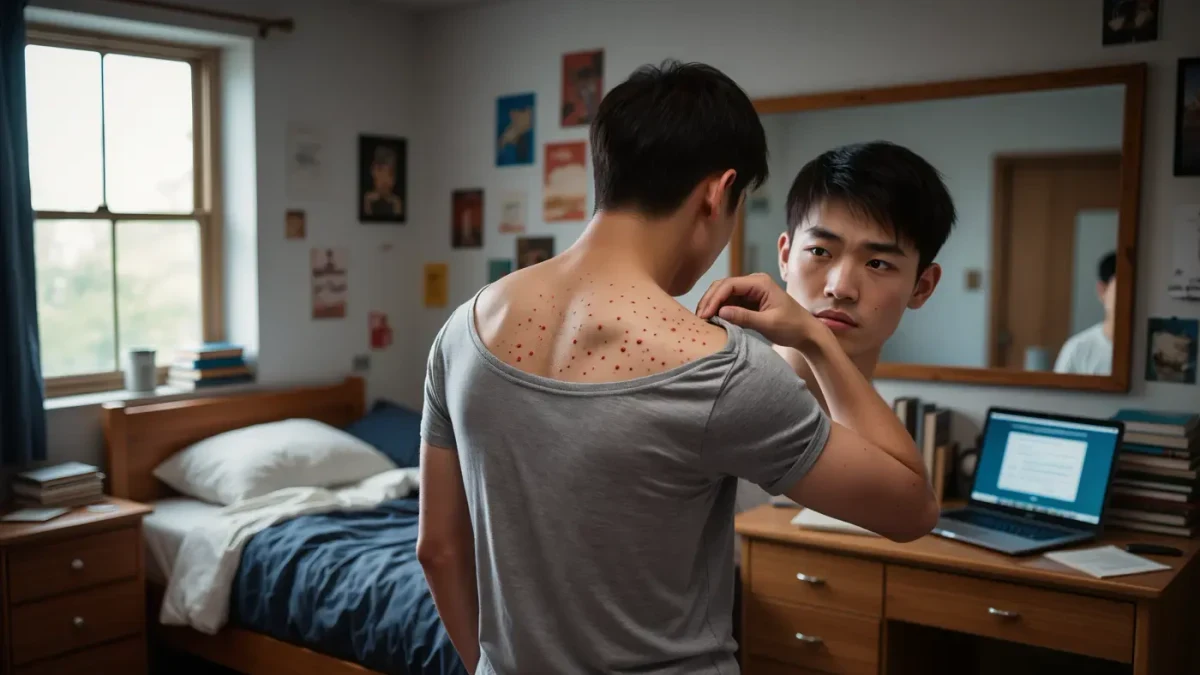
Fungal acne — the informal name for Malassezia folliculitis — is an overgrowth of yeast inside hair follicles, and the fastest way to tell it from regular acne is the pattern: dozens of uniformly small, itchy bumps clustered on the chest, upper back, shoulders, or hairline, without the blackheads and whiteheads of ordinary acne. Regular acne is driven by oil production, clogged pores, and bacteria such as Cutibacterium acnes; Malassezia folliculitis is driven by a yeast that feeds on those same skin oils and flares in heat and sweat. Dermatological reviews note that the condition is frequently misdiagnosed as acne, which is why standard benzoyl peroxide treatments often do nothing for it.
Only a clinician examining the bumps — sometimes with a skin scraping or a simple Wood's lamp — can confirm the diagnosis, and several other conditions mimic both.
What is fungal acne, exactly?
Malassezia is a genus of yeast that lives harmlessly on most people's skin. Problems start when it multiplies inside follicles: the yeast digests sebum and produces fatty acids that irritate the follicle wall, producing inflamed bumps. In dermatology literature the condition is called Malassezia or Pityrosporum folliculitis, and case series describe it clustering in teenagers and young adults, in people who sweat heavily, and in anyone who has recently taken oral antibiotics — which clear the bacterial competitors that normally keep yeast in check.
Where it shows up
The distribution is a diagnostic clue in itself. Regular acne favors the face — chin, jawline, nose. Malassezia folliculitis favors the trunk: back, chest, shoulders, and the forehead hairline, where occlusion, sweat, and oil accumulate. Bumps on the face alone are statistically more likely to be ordinary acne; a uniform field of bumps across the upper back shifts the odds strongly toward the yeast.
How do you tell fungal acne from regular acne?
Compare five features: itch, uniformity, location, blackheads, and response to treatment. Fungal acne itches, presents as uniform bumps of the same size, favors chest and back, produces no blackheads, and barely responds to acne washes. Regular acne varies in size, often hurts rather than itches, includes comedones, and responds — imperfectly but measurably — to benzoyl peroxide or salicylic acid.
| Feature | Fungal (Malassezia) folliculitis | Regular acne |
|---|---|---|
| Sensation | Itchy, sometimes worse after sweating | Tender or painless, rarely itchy |
| Look | Uniform small bumps, same size | Mixed sizes, papules to deep cysts |
| Comedones | Absent — no blackheads or whiteheads | Common |
| Typical zones | Back, chest, shoulders, hairline | Face, jaw, neck |
| Responds to benzoyl peroxide | Little or none | Often improves |
| Responds to antifungals | Usually improves within weeks | No |
The last row cuts both ways: if a week of an over-the-counter antifungal cream visibly settles the bumps, that improvement supports the yeast diagnosis — one reason dermatologists sometimes use a treatment trial diagnostically.
What causes a Malassezia flare?
Four accelerants recur across published case series: sweat and occlusion, humid heat, oily skin and oily products, and disrupted skin flora after oral antibiotics. Tight synthetic workout gear worn damp for hours is a classic setup, and so is a heavy occlusive body oil in summer. Immunosuppression raises risk as well, which is part of why persistent widespread flares deserve medical evaluation rather than cosmetic troubleshooting alone.
- Prolonged sweating: yeast thrives in warm, moist follicles.
- Occlusive clothing and gear: pads, backpack straps, tight sports bras.
- Oily skincare or hair products: the yeast feeds on certain lipids, especially esters and fatty acids with specific chain lengths.
- Recent oral antibiotic courses: bacterial competitors are removed, per dermatology case reports.
How is fungal acne treated?
First-line treatment is topical antifungal medication: over-the-counter ketoconazole 1 percent shampoo used as a body and scalp wash two to three times weekly, left in contact for several minutes before rinsing, or an antifungal cream such as clotrimazole applied to affected zones. Dermatologists prescribe oral antifungals for stubborn or extensive cases, with liver-enzyme monitoring in some patients — a medical decision, not a self-prescribed one. Results with topical therapy typically appear within two to four weeks, and maintenance washing once or twice weekly helps prevent relapse in people who sweat heavily.
What about regular acne products?
Benzoyl peroxide and salicylic acid target bacteria and clogged pores, neither of which drives Malassezia folliculitis — this is precisely why weeks of diligent acne washing produce nothing on fungal bumps. Some dermatologists note mild benefit from benzoyl peroxide's drying effect, but the response is unreliable. If an acne wash has done nothing after a month on uniform trunk bumps, the working hypothesis should flip to the yeast.
Can skincare and lifestyle changes prevent it?
Yes, and the changes are mechanical more than cosmetic: shower and change out of damp workout clothes promptly, choose loose breathable fabrics for exercise, keep heavy occlusive oils off the trunk in hot months, and wash workout gear between wears. People prone to flares often maintain a weekly antifungal shampoo wash through humid seasons. None of these steps replaces treatment during an active flare; they shorten the odds of the next one.
The pattern beats the product: itchy, uniform, trunk-distributed bumps are a dermatology question, not a new cleanser question.
When should you see a dermatologist?
Book an appointment if bumps persist after four weeks of over-the-counter antifungal treatment, if they spread rapidly, if they are painful, or if you cannot tell the pattern apart — mixed presentations happen, and acne and Malassezia folliculitis can coexist on the same person. A clinician can confirm the diagnosis with a scraping examined under potassium hydroxide preparation, and rule out lookalikes including bacterial folliculitis, keratosis pilaris, and heat rash. Anyone who is immunocompromised should involve a physician at the first persistent flare rather than self-treating.